
The junior developer cliff
AI coding tools are persuading many engineering leaders to hire fewer juniors. That saves money this year and creates a shortage of mid-level and senior engineers later. Here is how CTOs can keep the pipeline alive without overhiring.

Every engineering leader has heard the argument by now. AI coding assistants handle the boilerplate, the tests and the first draft of a feature, so a senior engineer with good tools can do the work that used to need a junior or two. On a spreadsheet, it looks like an easy saving.
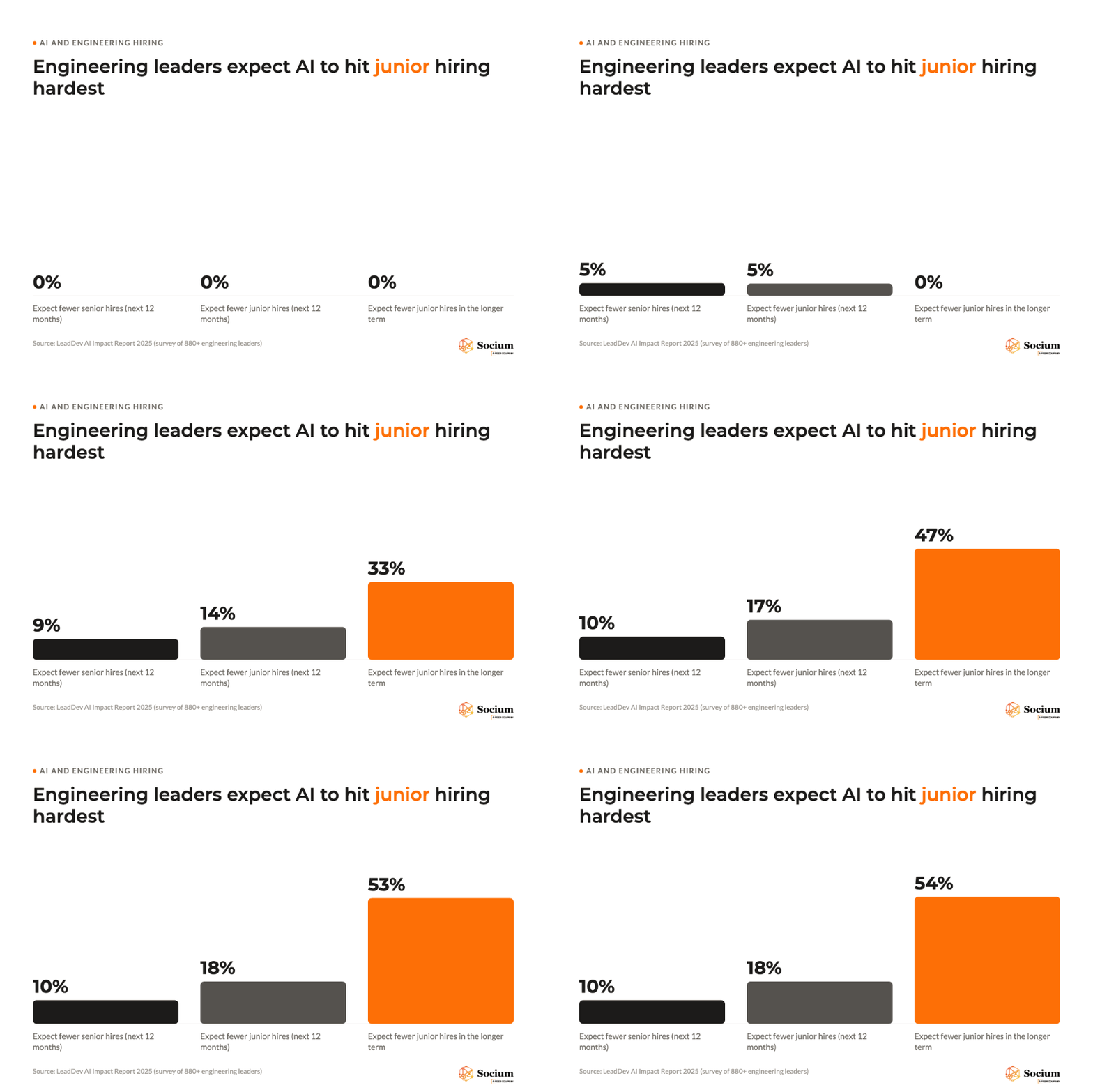
The numbers suggest many leaders are acting on it. In LeadDev's AI Impact Report 2025, a survey of more than 880 engineering leaders, 18% expected fewer junior hires over the next 12 months, compared with 10% expecting fewer senior hires. Over the longer term, 54% said AI coding tools would reduce hiring for junior developers.
Why the saving is borrowed from the future
Senior engineers do not appear from nowhere. Today's tech leads were juniors five to eight years ago, learning on production incidents, code reviews and unglamorous tickets. Cut the intake now and the shortage does not show up this quarter. It shows up around 2030, when you need engineers who understand your systems, your domain and your standards, and the market has very few of them to sell you.
Leaders know this. In LeadDev's Engineering Leadership Report 2025, 54% of the 617 leaders surveyed were concerned about AI's impact on junior developers entering the industry, up from 43% the year before. The concern is real, but concern is not a plan.
There is a second risk that gets less attention: the work does not disappear when juniors do. It shifts onto seniors, who now review more AI-generated code, field more questions and carry more context. Burnout among your most expensive people is not a saving.
Signs your pipeline is already at risk
- Your last three engineering hires were all senior, and nobody can name the next person ready to step up to tech lead.
- Seniors spend more time reviewing AI-generated code than designing systems, and nobody is learning from those reviews.
- Your graduate or apprentice scheme was paused "temporarily" more than a year ago.
- Knowledge of critical systems sits with two or three people who are also your best candidates to leave.
If two or more of these sound familiar, the cliff is not theoretical. It is already on your roadmap.
Five ways to keep the pipeline alive
1. Redesign the junior role instead of removing it. The junior job of 2022, writing small features from scratch, is genuinely changing. The junior job of 2027 looks more like reviewing, testing and integrating AI-generated code, writing the specification an agent works from, and owning the quality of a small component end to end. That is still a learning role. It simply builds judgement earlier than it used to.
2. Pair every junior with a senior and an agent. The most effective model we see is a three-way loop: the junior drives, the AI assistant drafts, and a senior reviews with the junior rather than for them. Make the review conversation the point. If AI does all the drafting and nobody explains why a suggestion is wrong, the junior learns to accept code, not to understand it.

3. Protect mentoring time on purpose. In the same LeadDev survey, 38% of leaders agreed that AI tools have reduced the amount of direct mentoring junior engineers receive from seniors. Mentoring rarely survives on goodwill when delivery pressure rises. Put it in team rituals and objectives: a fixed weekly pairing slot, a named mentor for each junior, and senior performance goals that include developing others.
4. Hire juniors in small cohorts, not one at a time. A cohort of three or four starting together shares onboarding, learns from each other and gives seniors one structured programme to support instead of scattered interruptions. Track time to first production change and time to independent ownership, so the investment has visible returns at budget time.
5. Flex capacity at the edges, not at the entry point. Many teams cut junior roles because they need to show cost control. The better lever is usually the peaks: specialist contractors or a managed team for a migration, a launch or a backlog surge, released when the work is done. That keeps your permanent structure, including the intake, stable while costs follow demand.
of engineering leaders expect AI to reduce junior developer hiring in the longer term. The organisations that keep a well-designed intake will have the mid-level engineers everyone else is competing for in 2030.
What this means for your 2027 plan
None of this means hiring juniors you cannot support. A smaller intake with real mentoring beats a large one left to learn from autocomplete. It does mean treating early-career hiring as part of your engineering strategy rather than a line to cut. Gartner expects generative AI to require 80% of the engineering workforce to upskill through 2027, so the skills you need are changing for everyone, not only for new starters.
Ask three questions in your next planning cycle: who will be our senior engineers in five years, which of today's junior tasks have changed rather than disappeared, and where can flexible capacity absorb peaks so the core team can keep investing in people.
Frequently asked questions
Will AI coding tools replace junior developers?
Not entirely. AI changes which tasks juniors do, shifting them towards reviewing, testing and integrating AI-generated code, but organisations still need a pipeline of engineers who grow into mid-level and senior roles.
Why does reducing junior hiring create a risk?
Senior engineers are developed from junior and mid-level engineers over five to eight years. Cutting the intake now leads to a shortage of experienced engineers later, when they are hardest to hire.
How can CTOs support juniors in AI-heavy teams?
Redesign the role around review and integration, pair juniors with seniors on AI-generated code, protect mentoring time and hire in small cohorts with clear ramp-up measures.
How can teams control cost without cutting junior roles?
Use flexible capacity, such as specialist contractors or a managed team, for project peaks, so permanent structures and early-career intake stay stable.
Sources
- LeadDev, AI Impact Report 2025: what it means for early-career engineers
- The New Stack, LeadDev Engineering Leadership Report 2025
- Gartner, "Generative AI will require 80% of engineering workforce to upskill through 2027" (October 2024)
Specialist Staffing
Need senior engineers to mentor your juniors, or specialists for a project peak? We source and vet niche technology talent fast.
Explore Specialist Staffing ›Build the team you need, where you need it.
Tell us what you need to deliver. We’ll come back with the right team, fast.