
Nearshore, offshore or onshore?
Where your engineering team sits now shapes cost, speed and control as much as who is in it. A practical guide to choosing between nearshore, offshore, onshore and blended delivery for 2027 plans.

For most technology leaders the question is no longer whether to build teams outside the home office. It is where, for which work, and how to keep control when the team spans several countries. Budgets for 2027 are tight, modernisation programmes are large, and specialist skills are scarce in every market. The delivery model you choose decides how far your budget stretches and how much control you keep.
There is no single right answer. Each model is good at different things, and the strongest setups usually combine them.
The four delivery models in plain terms
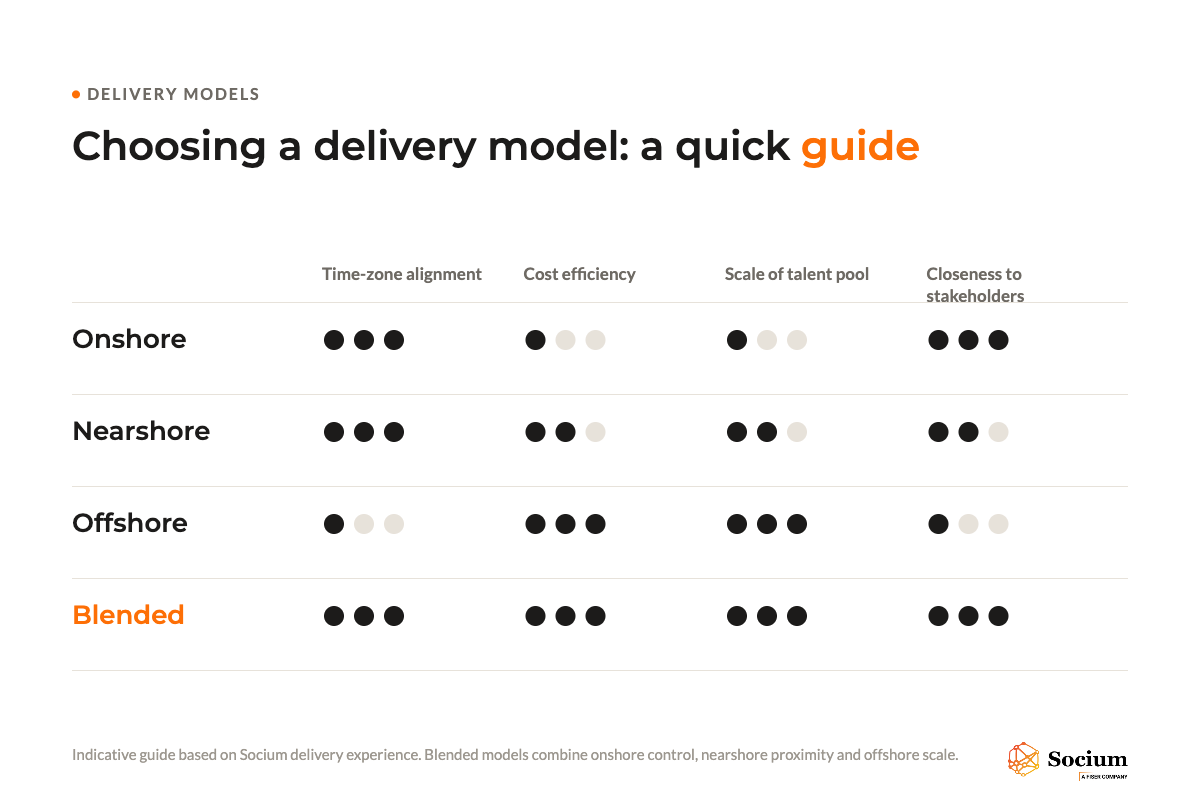
Onshore means the team works in the same country as your business. It is the most expensive option and the easiest for collaboration with stakeholders. It suits architecture, governance, product leadership and any role that spends its day with the business.
Nearshore means a nearby country in a similar time zone, such as Spain or Portugal for a UK or northern European business. It balances cost, quality and collaboration well, and suits development, data and platform teams that need regular contact with your people.
Offshore means a more distant location, such as the Philippines, with a larger talent pool and lower operating costs. It suits larger team builds, testing, development and long-running support, where work can be planned and handed over across time zones.
Blended combines all three: onshore leadership and control, nearshore proximity for close collaboration and offshore scale for capacity.
Six questions that decide the right mix
1. How much real-time collaboration does the work need? Discovery, product design and incident response need overlapping hours. Well-specified build and test work can run across time zones.
2. How stable is the scope? Stable, long-running work suits offshore teams that can grow deep knowledge. Fast-changing scope suits teams closer to the decision-makers.
3. Which skills are scarce where you are? If you cannot hire SAP, data or cloud specialists locally at a sensible rate, look at where those skills are concentrated.
4. What does compliance require? Data residency, security clearance and regulated workloads may keep certain roles onshore or in specific jurisdictions.
5. How quickly do you need to scale? Larger talent pools let you add people faster, which matters when a programme needs to double in size in a quarter.
6. Who will own delivery? Whatever the location, decide early that your organisation keeps control of priorities, governance and outcomes, and that partners provide talent, mobilisation and support rather than a black box.

Cost is not the only number
Lower day rates are the most visible benefit of nearshore and offshore delivery, but they are only part of the picture. The total cost of a delivery model includes management time, travel, onboarding, knowledge transfer, rework when requirements are misunderstood and the cost of delay when a team cannot scale fast enough. A cheaper team that needs twice the oversight is not cheaper.
Compare models on cost per delivered outcome rather than cost per person: how much it costs to get a feature, a migration wave or a support service live and stable. That comparison usually favours a blended model, with the most expensive onshore time reserved for the decisions that need it.
Common pitfalls to avoid
- Splitting one team across too many time zones, so nobody overlaps long enough to solve problems together.
- Sending only the routine work offshore, which makes roles hard to fill and keeps knowledge concentrated onshore.
- Treating partners as a black box, instead of keeping visibility of who is on the team and how they are performing.
- Skipping knowledge transfer, so capability leaves when a contract ends.
What good looks like in practice
Nearshore can move faster than many expect. Infront, an investment management software company, worked with Socium to deploy a 30-person nearshore engineering team in Spain within 10 working days to accelerate the modernisation of its legacy platforms. Offshore delivery can transform cost: a UK managed services provider built a 24/7 service desk in the Philippines with savings of up to 70% compared with in-house staffing. And at enterprise scale, AVEVA's programme with Socium deployed 219 resources across 12 countries.
to mobilise a 30-person nearshore engineering team in Spain for Infront's platform modernisation.
A simple way to start
- List the workstreams in your 2027 plan and score each on collaboration need, scope stability and skills scarcity.
- Keep leadership, architecture and stakeholder-facing roles onshore.
- Place collaborative build work nearshore and well-defined, scalable work offshore.
- Agree one operating model: shared tools, standards, overlap hours and reporting.
- Review the mix every six months as priorities change.
Frequently asked questions
What is the difference between nearshore and offshore delivery?
Nearshore teams work in nearby countries with similar time zones, which makes collaboration easier. Offshore teams work in more distant locations with larger talent pools and lower costs, suited to larger, well-defined work.
When should a role stay onshore?
Roles that spend most of their time with stakeholders, such as architecture, governance, product leadership and some regulated or security-cleared work, usually stay onshore.
What is a blended delivery model?
A blended model combines onshore leadership and control, nearshore proximity for collaboration and offshore scale for capacity, often giving the best balance of cost and quality.
How do you keep control of a distributed team?
Keep ownership of priorities, governance and outcomes in-house, agree one operating model with shared tools and standards, and use partners for talent access, mobilisation and support.
Global Delivery
Nearshore, offshore and onshore technology teams, or a blend, with contractors deployed across 51 countries.
Explore Global Delivery ›Build the team you need, where you need it.
Tell us what you need to deliver. We’ll come back with the right team, fast.