
SAP ECC's final year: staffing your S/4HANA move
Mainstream maintenance for SAP ECC 6.0 ends on 31 December 2027. For most organisations the hardest part of the move to S/4HANA is no longer the technology. It is finding the people, at the same time as everyone else.

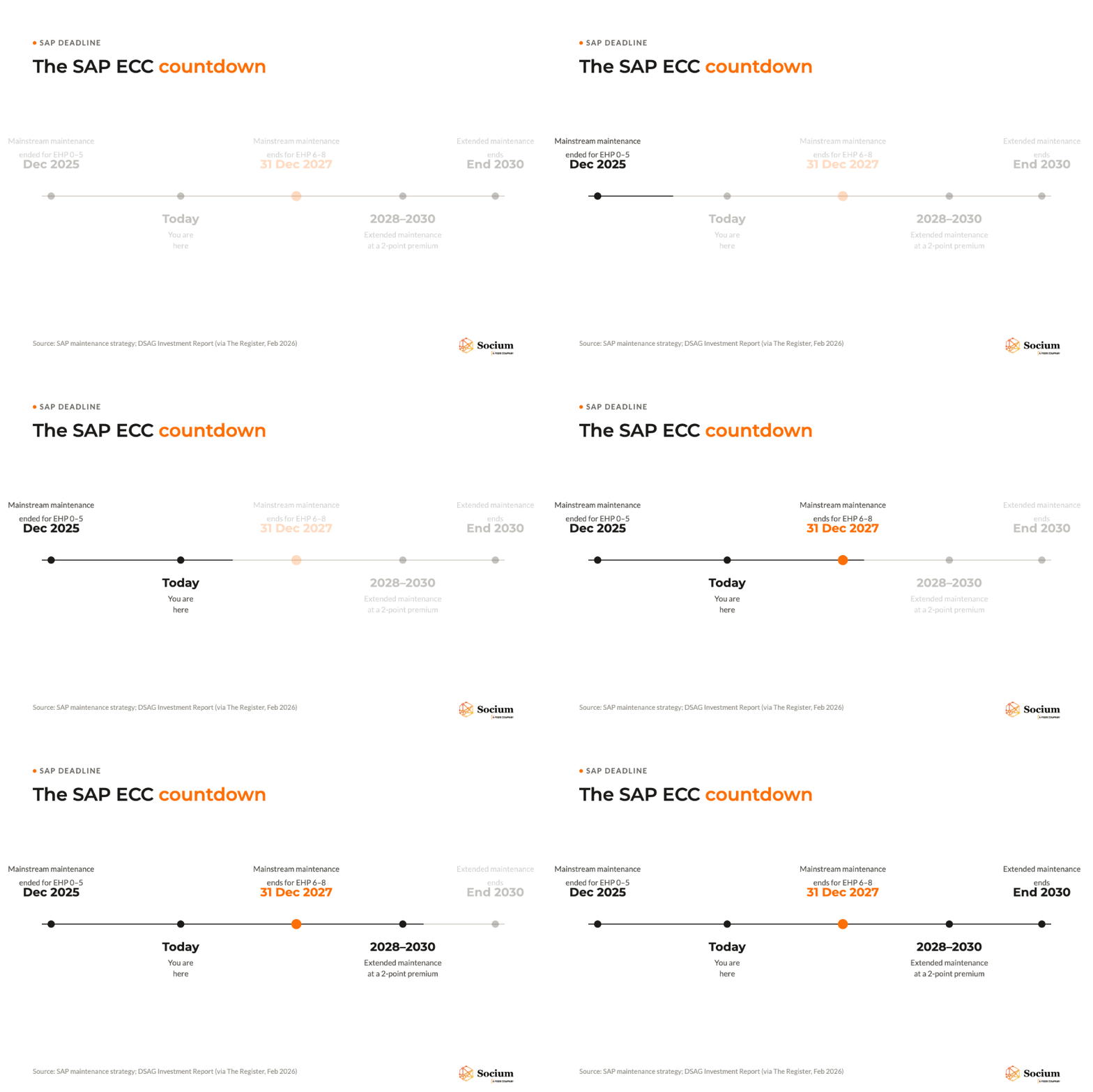
The date has been known for years. For SAP ERP 6.0 on enhancement packages 6 to 8, mainstream maintenance ends on 31 December 2027. Systems on enhancement packages 0 to 5 already left mainstream maintenance at the end of 2025. After 2027, extended maintenance is available until the end of 2030 at a premium of two percentage points on the maintenance basis, and after that customers move to more limited customer-specific maintenance.
Many organisations will not finish by then. A study by DSAG, the German-speaking SAP user group, found that of members still investing in ECC, almost half plan to complete their move to S/4HANA by the end of 2030, and most are willing to pay the extended maintenance premium to get there. That is a sensible choice for programmes already under way. It also means demand for SAP talent will stay high well beyond 2027, because thousands of programmes will be running in parallel.
Why people, not software, set your timeline
An S/4HANA migration needs a wide mix of skills at the same moment: functional consultants for finance, supply chain and procurement, technical developers, data migration specialists, testers, integration engineers, and change and training leads. Each programme peaks at roughly the same point, usually in the build and test phases, which is exactly when every other programme in your market peaks too.
That is why SAP consultants and partners have been warning that the market for S/4HANA specialists will tighten further from 2027. When availability drops, two things happen: day rates rise and the best people are booked months in advance. Programmes that start recruiting at the build phase find themselves choosing from whoever is left.

The roles most programmes underestimate
- Data migration leads and analysts. Cleansing and mapping years of master and transactional data is usually the longest-running workstream and the one most often understaffed.
- Test managers and automation engineers. Regression testing across finance, logistics and integrations needs a dedicated team, not borrowed business users.
- Integration specialists. Every interface to banks, warehouses, payroll and third-party systems has to be rebuilt or retested.
- Change and training leads. New processes and screens fail without people who prepare the business to use them.
A staffing plan that survives the peak
1. Build a skills calendar, not a headcount number. List every role your programme needs, the phase it is needed in and for how long. A data migration lead may be essential for nine months; a specialist in a specific finance module might only be needed for twelve weeks. This calendar is the basis for every hiring and supplier decision.
2. Secure the scarce roles first. Architects, data migration leads and experienced functional consultants in your most complex modules are the hardest to find. Contract or commit to them early, even if they start before the work is fully defined. Paying for a few weeks of planning is cheaper than a three-month delay.
3. Use a blended delivery model. Not every role has to sit next to your finance team. Testing, development and parts of data migration can be delivered nearshore or offshore at lower cost, while process owners, architects and change leads stay close to the business. A blended team widens the talent pool and protects your budget when rates rise.
4. Keep control of delivery and knowledge. Whatever mix of partners and contractors you use, keep ownership of the design decisions, documentation and test assets in-house. Make knowledge transfer a deliverable with dates, so your team can run S/4HANA once the programme team rolls off.
5. Plan for 2030, not only 2027. If you will need extended maintenance, budget for it now and use the time well. A programme that lands in 2029 with a properly staffed, rested team is better than one that rushes to 2027 with gaps in testing and data quality.
Mainstream maintenance ends for SAP ECC 6.0 on enhancement packages 6 to 8. Extended maintenance runs to the end of 2030, at a two-point premium on the maintenance basis.
Questions to ask this quarter
- Which enhancement package are we on, and which deadline actually applies to us?
- Have we chosen a go-live date and worked backwards to a skills calendar?
- Which three roles would delay the programme most if we could not fill them, and do we have them secured?
- Which workstreams could be delivered nearshore or offshore without hurting quality?
- Who owns the knowledge when the programme team leaves?
The deadline is fixed. The quality of your team is not. Organisations that treat staffing as part of the migration plan, rather than something to solve once the build starts, will reach S/4HANA with fewer surprises and a lower bill.
Frequently asked questions
When does SAP ECC mainstream maintenance end?
For SAP ERP 6.0 on enhancement packages 6 to 8, mainstream maintenance ends on 31 December 2027. Systems on enhancement packages 0 to 5 left mainstream maintenance at the end of 2025.
Can SAP ECC be supported after 2027?
Yes. Extended maintenance is available from 2028 to the end of 2030 at a premium of two percentage points on the maintenance basis, after which customer-specific maintenance applies.
Why is staffing an S/4HANA migration difficult?
Many organisations are migrating at the same time, so demand for functional, technical, data migration and testing specialists peaks together, which raises rates and reduces availability.
How can organisations reduce S/4HANA staffing risk?
Build a skills calendar, secure scarce roles early, use a blended nearshore, offshore and onshore team, and keep ownership of design and knowledge in-house.
Sources
- The Register, "Half of German-speaking SAP users set to blow past 2027 ECC support deadline" (February 2026)
- SAPinsider, SAP support deadlines: 2027, 2030 and 2033
- Redress Compliance, SAP ECC end of maintenance strategy
- IBsolution, End of maintenance for SAP ECC in 2027: what companies can still do now
Teams as a Service
SAP S/4HANA functional, technical, data and testing specialists as a scalable team, nearshore, offshore or onshore, with you in control of delivery.
Explore Teams as a Service ›Build the team you need, where you need it.
Tell us what you need to deliver. We’ll come back with the right team, fast.